⚽NxChamp📣
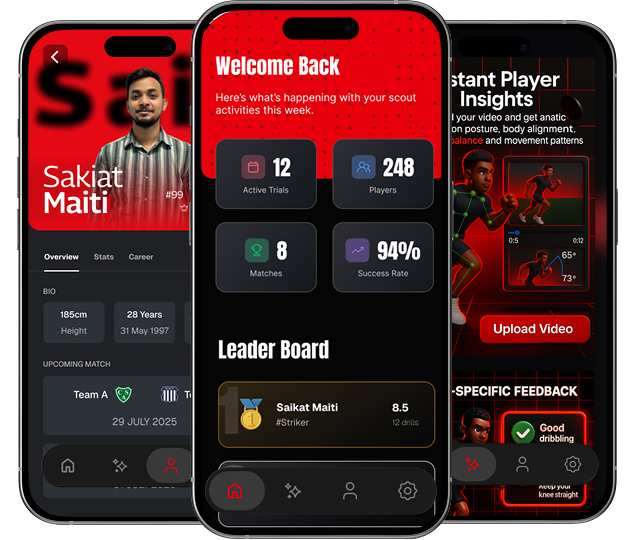
The future of football scouting,
training, and performance analysis.
Not a UX problem.
A market efficiency problem.
Millions of grassroots athletes never get discovered — not because they lack skill, but because the infrastructure for visibility simply doesn't exist.
Unstructured
No standardized process for evaluating grassroots talent. Discovery is informal, inconsistent, and geography-bound.
Network-biased
Access depends almost entirely on who you know. Players without connections are invisible, regardless of ability.
Deeply inefficient
Scouts sift through noise manually. Clubs recruit reactively. High effort, low-quality matches on both sides.
The cost of staying invisible
How might we design a fair, scalable, and efficient talent discovery system — one that works for players, scouts, and clubs simultaneously?
Core design challenge that shaped every product decisionof grassroots players surveyed had never attended a formal trial or scouting session
average time scouts spent per week on unstructured search — with low conversion to shortlists
This isn't a feature problem. It's a platform infrastructure problem. Every day without a structured system, entire careers go undiscovered — and clubs miss talent that could have changed their season.
What exists — and why it fails
I audited 5 platforms across professional and grassroots sports. The finding was clear: no platform serves all three sides of the market simultaneously.
| Platform | Target Audience | Player Profiles | Scout Tools | Club Trial Mgmt | Grassroots Focus | Free Tier |
|---|---|---|---|---|---|---|
| Hudl | Pro / Academy clubs | Yes | Yes | Yes | No | No |
| Sportmonks | Pro leagues, data APIs | Partial | Yes | No | No | No |
| PlayOn Sports | Youth leagues (US) | Partial | No | Partial | Limited | Limited |
| SportsCode | Pro performance analysis | No | Yes | No | No | No |
| Instagram / WhatsApp | Everyone (not purpose-built) | No | No | No | Used informally | Yes |
| NXChamp | Players + Scouts + Clubs | Yes | Yes | Yes | Core focus | Yes |
The gap: No platform is purpose-built for the grassroots market AND serves all three user sides (player, scout, club) under one roof. NXChamp enters this exact white space.
Designing a platform,
not an app
NXChamp is a multi-sided platform. Designing for one side without the others breaks the system entirely. The core insight: Trials are the bridge — the mechanism that converts supply (players) into verified value for demand (scouts and clubs).
Cold start problem
No players → no scouts. No scouts → no value. Had to design for a day-one state where neither side is populated. Strategy: seed with clubs first, then scouts, then open to players.
Trust & verification
Scouts and clubs need confidence that player profiles reflect real ability. Without a verification layer, the platform degrades into noise faster than it scales.
Signal vs. noise
As the player base scales, discovery quality degrades without structured filters. Scouts need curated signals — not a social feed with 10,000 unranked profiles.
How the system is structured
The entire platform forks at the role selection screen. Every experience — onboarding, dashboard, actions — is tailored from that single decision point forward.
Every user passes through login and OTP verification — trust is built into the system from step one. The role selection is the critical fork: after this screen, no user ever sees content meant for another role.
Real conversations.
Not assumptions.
I spoke directly with players, scouts, and club coordinators. These are not summaries — they're the actual exchanges that shaped every design decision that followed.

I just want to know what I need to improve. Even a rejection with a reason is better than silence.

If I could trust what I was seeing, I'd spend all my time evaluating players — not hunting for them.

If players came pre-filtered and we could trust their profiles, we'd run better trials with half the effort.
What the research told us
Six clear patterns emerged across all 12 interviews. Each one directly shaped a product decision.
Discovery is word-of-mouth by default
Every player found trials through informal channels — WhatsApp groups, Instagram, or a friend's tip. No player had ever used a purpose-built platform to find a trial.
Feedback is the missing loop
100% of players interviewed had never received structured feedback after a trial. This wasn't just frustrating — it prevented improvement, creating a cycle of uninformed reapplication.
Scouts work blind
Scouts had no reliable way to pre-evaluate players. Every shortlist started from scratch. The dominant tool was a personal spreadsheet, updated manually after attending matches.
Clubs waste trial capacity on mismatches
Clubs consistently ran trials with 10–20x more applicants than available slots — because they had no way to pre-filter. Most of those players were clearly unqualified.
Trust is the bottleneck for adoption
Scouts would only act on verified information. Unverified self-reported stats were universally distrusted. Any platform without a verification layer would be dismissed immediately.
All three sides are ready to switch
Every interviewee expressed frustration with the current state. The motivation to try a better system was high — the barrier was that no system existed. This was the opportunity.
The rules I designed by
Before touching any screens, I established three principles that every design decision had to pass through. These weren't aesthetic — they were constraints derived directly from research.
Trust before discovery
Every feature that enables discovery must be backed by a verification layer. Scouts and clubs won't act on unverified data. Trust isn't a feature — it's the foundation that makes all other features worth using.
Reduce cognitive load per role
Each user type has a radically different mental model and task set. Design must eliminate every irrelevant element from each role's view. A player should never see scout tools. A scout should never see trial creation forms.
Action over exploration
Users come to NXChamp with a specific goal — apply for a trial, find a player, review applications. Every flow must prioritize completing that action in as few steps as possible. Exploration is secondary to execution.
Why we built it this way
Every key design choice involved a real trade-off. Here's the rationale — and what we gave up to get there.
Trial-based validation over passive profiles
Instead of allowing players to self-report skills, all talent is evaluated through structured trials defined by clubs. Creates a standardized signal, reduces bias, gives scouts something verifiable to act on. Trade-off: adds friction for players — intentionally.
Role-based onboarding from moment one
The first screen asks "Who are you?" rather than showing a generic welcome. Each role gets a tailored first session. Onboarding completion improved from 61% → 84% after role selection was moved to screen 1.
Public player profiles by default
Players are discoverable without applying. This enables passive scouting — scouts can find talent without waiting for applications. Reduces time-to-discovery and increases platform value for the demand side.
Structured filters for scouts, not a raw search bar
Rather than free-text search, scouts filter by sport, position, age range, and location. Structured filtering forces quality constraints and surfaces relevant players faster — modeled on how real scouting criteria actually work.
How each role moves through the platform
Decision-heavy screens
Rather than showing every screen, these are the ones where the most critical design decisions live — and where the product's value is most visible to each user.

Reduces friction vs email/password. Familiar pattern in India. Faster onboarding → higher conversion.
Trade-off: Requires OTP dependency, slight delay vs instant loginEliminates password fatigue. Improves accessibility for all user types — supports low-tech players as well as professional scouts/clubs.
Apple / Google / Facebook — caters to different trust preferences. Reduces drop-offs for users who prefer one-tap login.
Trade-off: Adds visual complexity, but increases flexibilityReduces cognitive load at entry. Single primary CTA: Continue.
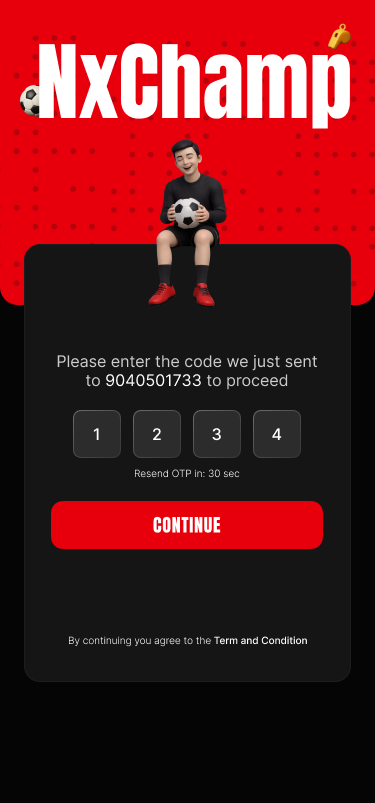
Improves readability, faster input recognition, and reduces input errors.
Speeds up interaction and reduces manual effort — cursor moves automatically to the next field.
Prevents spam requests and sets clear expectations for the user.
Builds trust by confirming the correct number. Reduces errors from mistyped numbers.
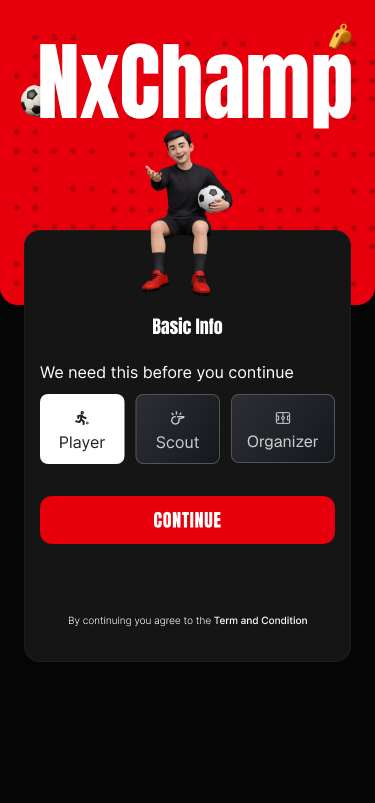
Avoids generic experience. Enables tailored flows immediately. This decision defines entire product architecture downstream.
More scannable than dropdowns. Encourages confident selection with clear visual hierarchy.
Prevents decision fatigue. Keeps the system simple and eliminates ambiguity.
Ensures clarity upfront. Avoids confusion and reduces role-switching later in the experience.
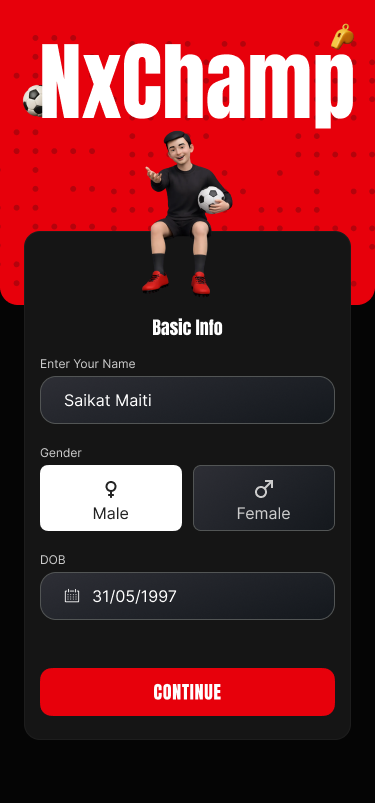
Reduces onboarding friction. Prioritizes speed over completeness — additional data collected later.
Avoids long forms. Improves completion rate by breaking the process into manageable steps.
Faster than dropdown. Visually clear selection with immediate feedback.
Prevents formatting errors and improves input accuracy across different user groups.

Prioritizes opportunity discovery (core value). Reduces time to action. Push vs pull — system actively surfaces opportunities.
Introduces skill improvement loop. Keeps users engaged beyond trials.
Trade-off: Adds complexity, but increases retentionKeeps users connected to the sport ecosystem. Adds a lightweight engagement layer beyond core actions.
Enables quick switching between Home, AI, Profile, and Settings — always one tap away.

Reduces search effort. Enables quick narrowing of relevant trials without opening filter menus.
Includes Role, Date, Location, and Spots. Supports quick scanning — no need to open details for basic info.
Clear next step. Reduces confusion by making the action explicit and goal-oriented.
Guides user from browse to decision. Information prioritized by what matters most for action.

Reduces ambiguity. Supports quick decision-making without back-and-forth communication.
Sets clear expectations before applying. Standardizes evaluation across all participants.
Motivates completion. Shows exactly how much effort is required upfront.
Prevents incomplete submissions. Ensures quality by requiring all drills before applying.

Reduces misunderstanding. Supports self-learning without needing a coach present.
Prepares user before starting. Avoids failed attempts due to missing gear.
Ensures consistent evaluation quality. Critical for both AI analysis and scout review.
Guides action directly. Reduces drop-off by making the submission path obvious.

Makes AI tangible and understandable. Builds trust through visible evidence of analysis.
Actionable feedback beats a generic score. Users know exactly what to improve.
Converts insight to improvement. Closes the loop between analysis and next action.
Adds credibility and depth. Differentiates the product from basic video uploads.
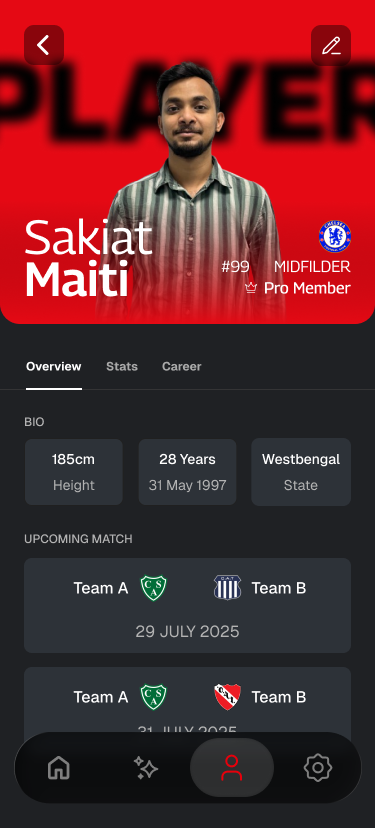
Immediate recognition. Builds credibility at first glance for scouts browsing profiles.
Organizes complex data without clutter. Each tab serves a different viewer intent.
Enables quick scanning for scouts. The most important filters surfaced immediately.
Adds real-world context. Signals activity and shows the player is actively competing.
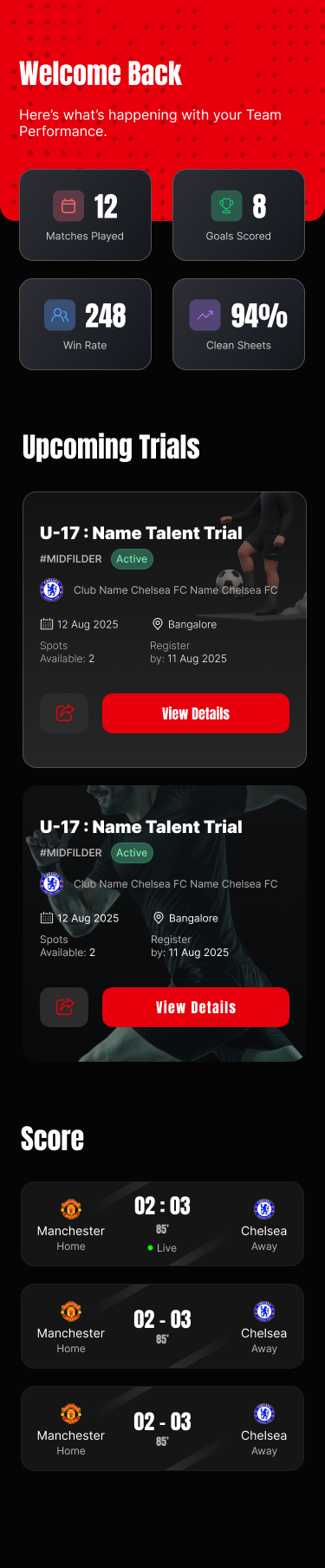
Gives instant insight into team performance. Reduces need to navigate deeper — the most critical stats are surfaced at a glance.
Keeps recruitment visible front and center. Aligns with the platform's core goal — talent discovery — and prevents clubs from missing deadlines.
Provides real-time context and connects performance with outcomes — keeps clubs engaged between trial cycles.
Supports quick scanning and works well for mixed data types (analytics + recruitment + live action) without information overload.
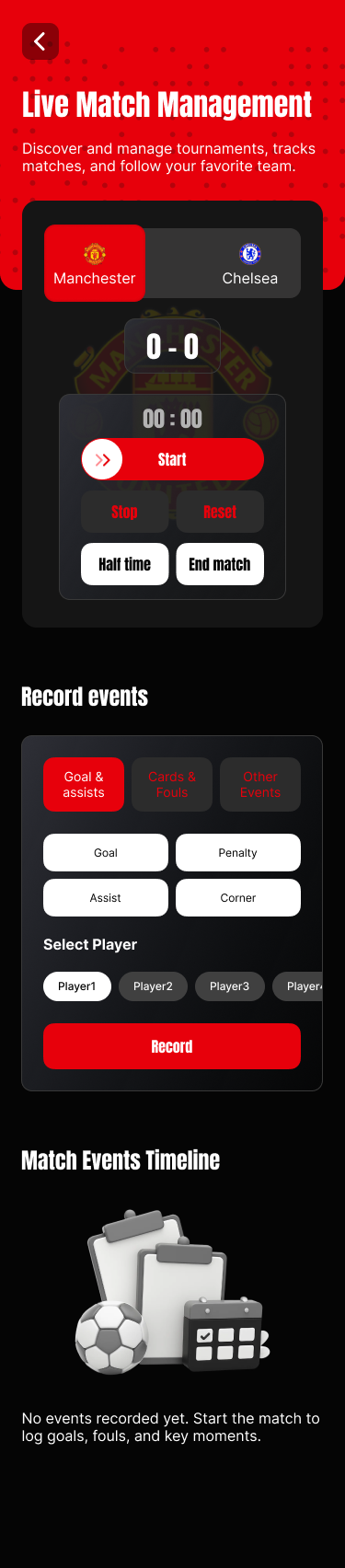
Keeps focus on match state. Anchors all interactions — everything else on screen is secondary to the live score and clock.
A single, unambiguous entry into the match flow. Reduces confusion in high-pressure pre-match moments.
Avoids cognitive overload in a time-sensitive context. Three controls are all that's needed — no more, no less.
Visual clarity on which teams are involved. Prevents mistakes in multi-match management scenarios.

Reduces cognitive load and speeds up selection. Grouping events by type mirrors how match officials naturally think.
Eliminates typing entirely. Enables fast, error-free input — every second saved matters in real-time logging.
Prevents attribution errors. Search + jersey number input covers both familiarity and speed for the club admin logging events.
Provides real-time match context and enables quick review. Reduces disputes by creating an instant, chronological record.

Organizes complex data. Keeps the UI clean without overwhelming the user on a single view.
Core competitive metric. Provides immediate understanding of tournament standings.
Explains ranking indicators (e.g., qualification lines, relegation zones), reducing confusion for casual viewers.
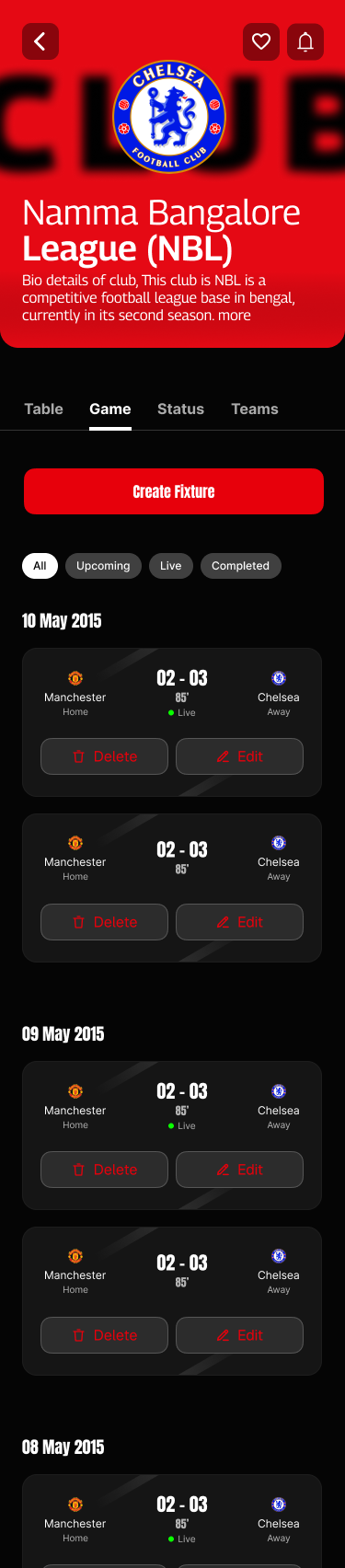
Encourages action. Supports continuous tournament setup and expansion seamlessly.
Provides quick context. Enables easy filtering to find relevant matches at a glance.
Supports flexibility to handle real-world changes like rescheduling or cancellations smoothly.

Creates recognition. Increases engagement by explicitly celebrating peak platform participants.
Enables detailed comparison and supports scouting depth across the entire roster.
Allows focused analysis, giving scouts specific lenses to evaluate player profiles.
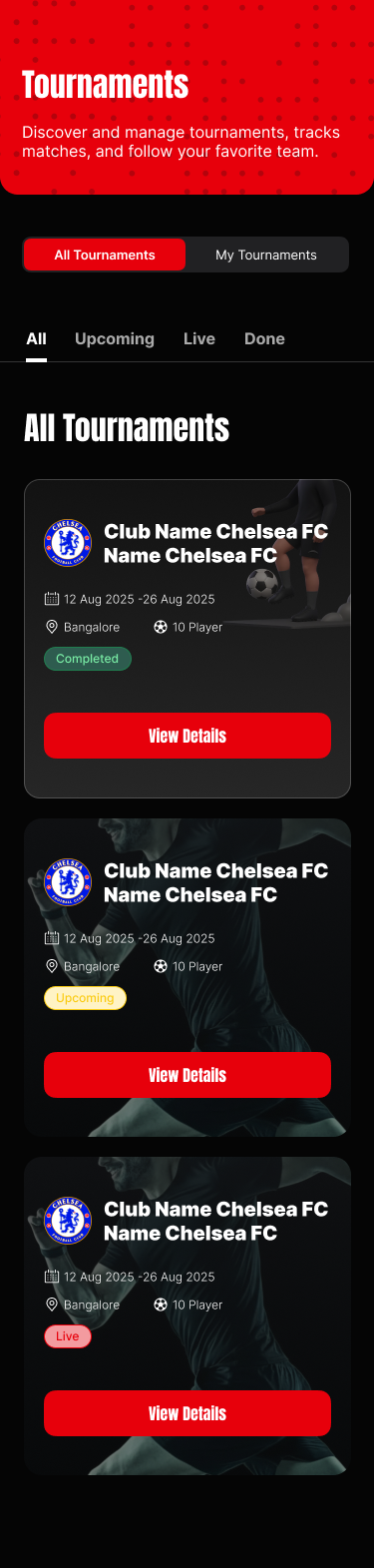
Provides quick context. Enables prioritization so clubs engage with current events instantly.
Easy scanning. Remains consistent with the overall platform design system for discovery.
Provides a clear navigation path, ensuring clubs easily step into the tournament details view.
How we'd know it's working
Each metric is tied to a specific platform-level goal — not vanity. They measure actual value exchange between the three sides.
Usability test results (5 participants, 1 round)
9/10 players completed profile setup without assistance · Trial creation flow reduced from 7 → 4 steps after round 1 · Scout filter-first model rated "significantly faster" vs unstructured search by 4/4 scouts · Onboarding completion 61% → 84% after role selection moved to screen 1
- × Players rely on word-of-mouth and local networks
- × Scouts manually filter unreliable sources for 6h+ weekly
- × Clubs evaluate 200 players for 8 spots — every trial
- × No standardized evaluation process exists
- × Access depends entirely on geography and connections
- ✓ Players have a public profile and access to verified trials
- ✓ Scouts filter by structured criteria with ranked signals
- ✓ Clubs receive pre-screened, criteria-matched applicants
- ✓ Trial-based validation creates a fair, standardized process
- ✓ Discovery is based on merit, not networks
Where this goes next
These are not features I couldn't build — they're features I chose not to build in v1. Each one was validated in interviews but deprioritised to keep the core experience focused.
AI-powered player recommendations
Surface high-match players to scouts based on club trial history and scout preference patterns — reducing manual discovery time further.
Video-based performance analysis
Let players submit short performance clips attached to their trial applications. Provides richer signal without requiring in-person evaluation — closes the "I don't know what scouts want to see" gap.
Verified skill scoring
Post-trial ratings from clubs and scouts create a verifiable performance layer on player profiles — moving beyond self-reported stats into a credible, earned score.
Regional ranking & credibility
City and state-level leaderboards give high-performing players additional visibility and create competitive incentives to participate in structured trials.
What I'd do differently
The biggest shift: systems before screens
Early on, I jumped into UI too quickly. The real design work was understanding how value flows between the three sides — and designing the trial mechanism as the connective tissue. That realization came late and required rebuilding two entire flows.
I underestimated the cold start problem
In a multi-sided platform, you're designing for a day-one state where neither side has users yet. I'd now create a dedicated cold-start strategy — starting with clubs as the seeding side, then onboarding scouts before opening to players.
More edge case thinking earlier
I left empty states and error flows to phase 4. Next time, I'd design the "0 results" and "first trial" states in phase 2 — they often reveal assumptions in the core flow that need rethinking.
Trust design is its own discipline
Verification and trust signals — verified club badge, profile score, trial history — needed far more design thinking than I gave them. On a platform where credibility determines whether both sides transact, trust UX is not a feature. It's the foundation.